


Indicator 35: Employment/population ratio


Rationale: A high employment/population ratio means that a large fraction of the population is working and paying taxes. It contributes to greater economic growth because employed people have more money to spend.
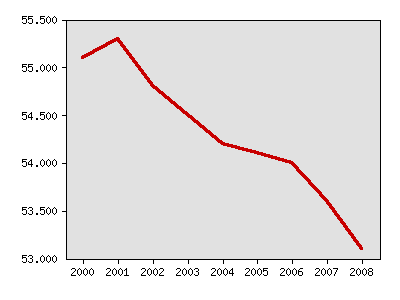
About this indicator: The employment to population ratio declined from 55.1 in 2000 to 53.1 in 2008. Slow job growth is probably a major reason for the decline. Baby boomer retirements and lower workforce participation by young adults are other possible factors.
Employment to population ratio
| Year | Data |
|---|---|
| Employment to population ratio, Minnesota Department of Employment and Economic Development and U.S. Census Bureau | |
| 2000 | 55.1 |
| 2001 | 55.3 |
| 2002 | 54.8 |
| 2003 | 54.5 |
| 2004 | 54.2 |
| 2005 | 54.1 |
| 2006 | 54.0 |
| 2007 | 53.6 |
| 2008 | 53.1 |
Things to think about: The aging of the baby boom generation is expected to produce a lower employment/population ratio in the future, with negative implications for state tax revenues.
Sources:
- Employment data from Minnesota Department of Employment and Economic Development LAUS data, http://www.deed.state.mn.us/lmi/Home.htm
- Population estimates from U.S. Census Bureau, http://www.census.gov/popest/estimates.html
Local data:


Milestones is a product of the Minnesota State Demographic Center, a division of the Department of Administration